



 Close

Investor Relations
Information to help investors gain a deeper insight into who we are
- HOME >
- Investor Relations >
- Archive >
- Message from the CFO
Message from the CFO
Basic Policy for Our Financial Strategy
Balancing Growth and Shareholder Returns through Disciplined Capital Allocation
Leveraging strong profitability and high capital efficiency to invest in research and development, human capital, and facilities; generate new products and markets; and return the benefits of those efforts to our shareholders. Strengthening this cycle and sustaining it over the long term is the basic policy of the Nissan Chemical Group’s financial strategy. We will continue to clarify our capital allocation standards and future direction through active dialogue with capital markets.
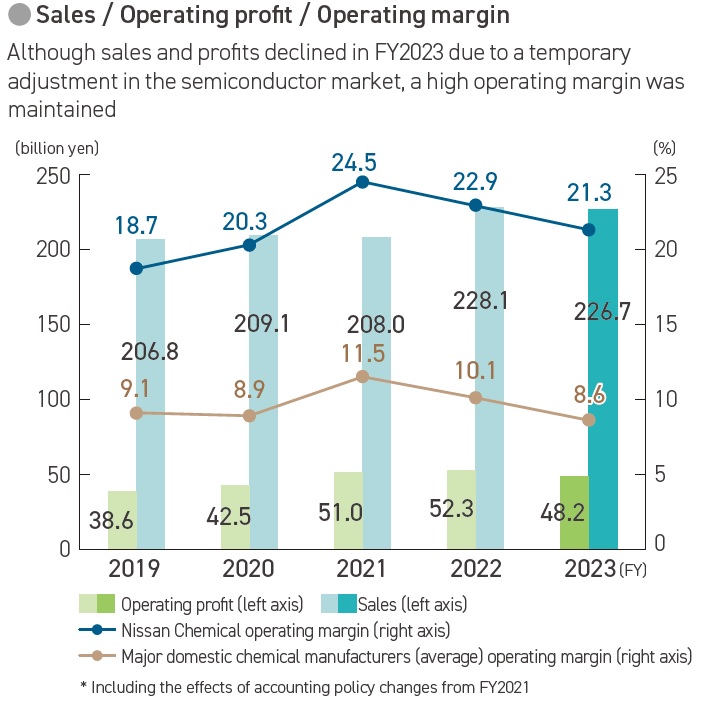
In FY2025, sales reached ¥279.6 billion, operating profit was ¥63.6 billion, and net income attributable to owners of the parent was ¥49.7 billion. Operating profit, ordinary income, and net income all reached record highs. Except for FY2023, we have achieved record-high profit every year since FY2012. In FY2026, we aim to achieve a fourteenth year of record-high profit.
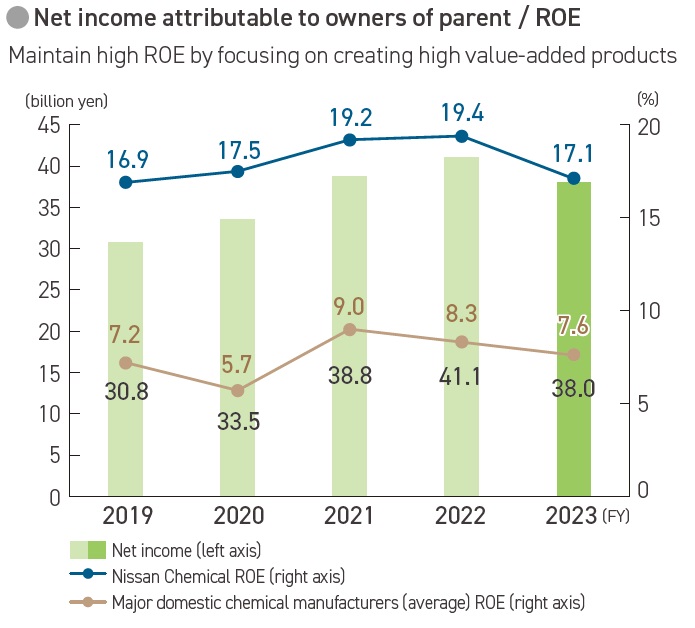
Return on equity (ROE) also exceeded 20% for the first time, reaching 20.3% in FY2025. Our market capitalization has grown to approximately ¥1 trillion. I believe that this heightened recognition in the capital markets will not be temporary and that we can continue to achieve solid growth going forward.
Demand for semiconductors is expected to expand over the long term, driven by the rapid adoption of generative AI and the increasingly important role of semiconductors as a foundation for society and industry. At the same time, short‑term adjustments and volatility remain significant. It is therefore essential that we closely monitor geopolitical risks, foreign exchange trends, raw material prices, and downstream demand, while maintaining investment in advanced product development. However, we are not a company dedicated exclusively to semiconductors. Our agricultural chemicals, which support increased food production and higher crop yields, benefit from stable, long‑term demand. Expanding our business through the twin pillars of Performance Materials, including semiconductor materials, and Agricultural Chemicals forms the backbone of our strength.
Rather than relying solely on semiconductor tailwinds, we aim to build an organization in which each business grows autonomously and remains resilient to changes in the business environment. In an environment marked by uncertainty and rising inflationary risks, balancing growth investment with risk management is also critical. We are diversifying procurement sources for essential raw materials and reassessing our supply chain to ensure business continuity and earnings stability.
Financial Policy for Enhancing Corporate Value
Connecting High Profitability to the Next Stage of Growth
ROE is the financial indicator to which we attach the greatest importance, as it is easy for both investors and employees to understand and provides a clear measure of capital efficiency. We view the 20.3% ROE achieved in FY2025 not as a destination but as a milestone. A number of companies have higher capital efficiency than we do. Without becoming complacent with this level, we will strive to reach greater through both profit growth and capital efficiency.
In addition to profit, our ability to generate free cash flow—which supports growth investment and shareholder returns—is also critical. Even if profit increases, growth investment and shareholder returns cannot be sustained without cash generation. As the cost of capital varies with market conditions, reflected in shareholders’ expected rate of return and interest rates, it is essential that we consistently deliver performance that exceeds the cost of capital and earn the trust of the capital markets.
To raise ROE, we will not sharply increase financial leverage or rely excessively on share repurchases. Instead, we will steadily enhance capital efficiency in tandem with business growth. Our path to higher ROE is to develop high-value-added products that are indispensable to customers in niche markets; improve profit margins and asset efficiency; and raise ROE through business growth. Through both our performance and continued dialogue with capital markets, we will strengthen trust and recognition in the capital markets.
Our FY2026 operating profit forecast is ¥66.8 billion, meaning we expect to achieve—and surpass—the FY2027 target of ¥65 billion set in our Medium‑term Business Plan “Vista2027 StageII” one year ahead of schedule. At the same time, I recognize that much of this upside is driven by semiconductor materials. While fulfilling our short‑term performance responsibilities, we will also maintain a long‑term perspective and continue cultivating new products.
Business Portfolio Assessment
Evaluating Investments from Multiple Angles Using ROIC as a Common Benchmark
We have established return on invested capital (ROIC) as a common benchmark across all businesses. We continuously assess how much profit each business generates from the capital invested, even after the investment has been made. When necessary investments in the advanced semiconductor field temporarily lowers ROIC, we rigorously evaluate the path to recovering those investments over the medium to long term and restoring ROIC to the target level.
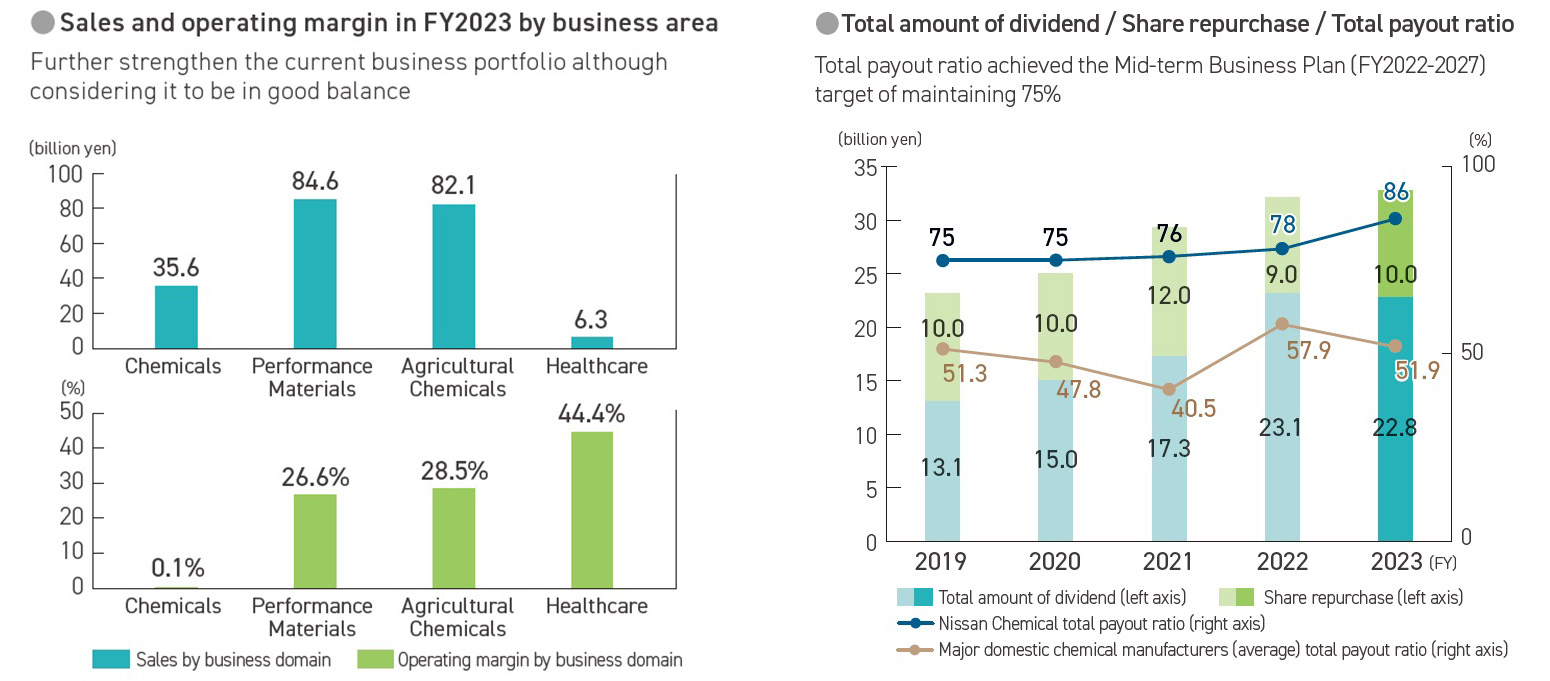
At present, ROIC in Performance Materials exceeds 30%, while ROIC in Agricultural Chemicals remains in the high‑teens. By capturing on high growth in the semiconductor market and strengthening Agricultural Chemicals—which offer both stability and room for expansion—we will enhance the resilience of our overall business portfolio.
We do not expect every business to achieve the same ROIC level. For businesses facing profitability challenges, we carefully assess the likelihood of profit growth while making necessary maintenance and replacement investments. What matters most is taking necessary, forward‑looking actions while assessing the balance between investment and profit, with a focus on how much cash each business can continue generating over the medium to long term. We will pursue disciplined portfolio management based on a comprehensive evaluation of each business’s competitiveness—including its technological foundations, customer relationships, future growth potential, and the ability to pass rising input costs from recent inflationary pressures on to customers through pricing.
Shareholder Return Policy Based on Growth Investment
Balancing Investment, Shareholder Returns, and the Balance Sheet
In our cash allocation, the highest priority is investment in research and development. The next priority is the capital investment necessary to launch new products and secure production capacity. We allocate the cash we generate primarily to the Performance Materials and Agricultural Chemicals. After investing in areas that will create future profit and cash flow, we return the remaining cash to our shareholders.
In FY2025, operating cash flow was ¥64.2 billion, and free cash flow was ¥43.0 billion. With dividends of ¥202 per share and ¥10.5 billion in share repurchases, our total payout ratio was 75.7%. For FY2026, we plan dividends of ¥212 per share, share repurchases of up to ¥10.5 billion, and a total payout ratio of 75.0%. I believe we have sufficient profitability and financial strength to sustain this policy at least through FY2027. Throughout the Medium‑term Business Plan period, we will maintain this approach without reducing necessary investment.
At the end of FY2025, our equity ratio was 71.9%. While carefully assessing the required level of cash and deposits, we will allocate the cash we generate prudently between growth investment and shareholder returns. A strong balance sheet also provides the foundation to act when opportunities arise. In M&A, we explore priority areas and potential targets, while remaining disciplined when valuations are elevated, carefully assessing fair value and making decisions based on both price and strategic fit.
Continuing Strategic Investment in Knowledge and People
Investing in the Sources of Growth —R&D and Human Capital
Our business model stands in stark contrast to mass production of commoditized, general‑purpose products. Our competitiveness comes from creating indispensable products and technologies—solutions that customers actively choose for their value. For this reason, we place strong emphasis on investing in intangible assets such as research and development, intellectual property, and human capital, continually strengthening our ability to generate high‑value‑added products. In manufacturing, we assess product value and demand visibility, and flexibly combine in‑house production with outsourced manufacturing.
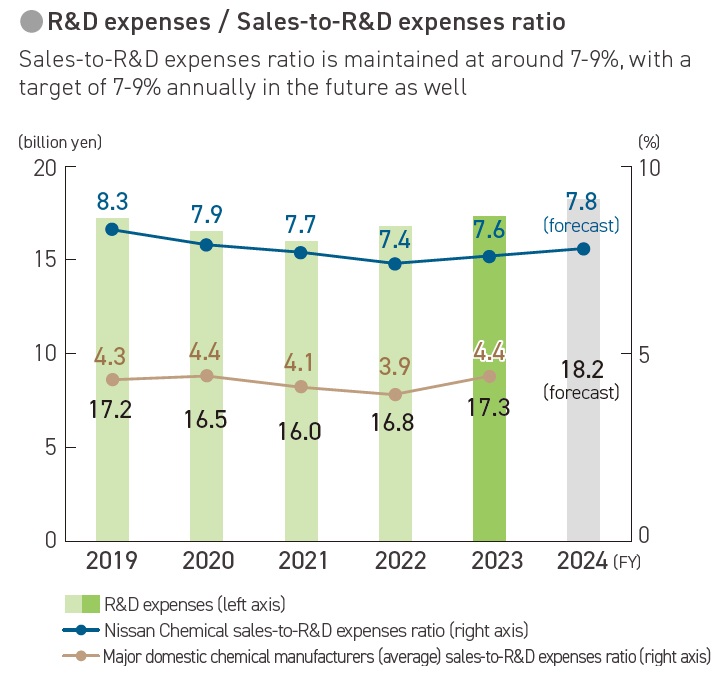
For FY2026, we plan R&D expenditures of ¥24.7 billion, representing an R&D expenses-to-sales ratio of 8.5%, and ¥27.0 billion in capex. Rather than simply increasing spending, we identify initiatives that will drive future revenue and profit growth, reviewing progress and business potential at each milestone. In semiconductor materials, our customer base is expanding, requirements are becoming more advanced, and faster response is essential. Strengthening our R&D workforce is an urgent priority. In agricultural chemicals, in addition to developing major new products, we are also investing in promising areas such as biological pesticides and veterinary pharmaceuticals. These are forward‑looking investments that will generate future sales of new products and earnings power.
People are the foundation of our R&D capabilities. Investment in human capital does not yield results overnight. Under a consistent HR policy, we recruit and develop outstanding talent, increasing the number of researchers who can identify high-potential research themes and guide those themes toward commercialization. At the same time, research is no longer conducted by individuals working alone. We promote co‑creation across fields and organizations, refining systems that turn individual strengths into organizational results. Because we have a proven track record, I believe we can leverage this strength to enhance corporate value.
Sustainable Growth Strategy
Linking Sustainability to Corporate Value
Society cannot function without the chemical industry—whether in healthcare, agriculture, electronic materials, construction materials, or logistics. Recognizing this role, chemical companies must fulfill their social responsibilities while achieving sustainable growth. As Chair of the Sustainability Promotion Committee, I also consider it essential to directly connect our efforts to fulfill our responsibilities as a chemical company supporting social infrastructure with our growth strategy. Climate change poses business risks, but it also creates demand for agrochemicals that improve yields even under harsh conditions. We will fulfill our responsibility to reduce environmental impact while addressing social challenges and linking these efforts to growth opportunities.
We plan to consider reviewing the 20 material factors established in 2022 in light of subsequent changes in the operating environment, with a view to clarifying their connection to our growth strategy. Likewise, we will avoid merely formal compliance in setting Scope 3 reduction targets aligned with SBT criteria and in disclosures based on SSBJ standards. Instead, we will clarify how these efforts connect to our growth strategy.
Within the company, understanding of the need for sustainability has become more widespread. The next challenge is enabling each employee—in manufacturing, R&D, and sales—to recognize how sustainability connects to their daily work. To translate non‑financial value into financial value, it is essential that people on the front lines understand and embrace this connection and take action on their own initiative.
Corporate Value Enhancement through Dialogue with Capital Markets
Turning Dialogue into a Source of Management Strength
Dialogue with capital markets does not end with explaining our financial results. It is an opportunity to understand what investors expect from us and what they perceive as risks, incorporate these insights into management decisions, and review our approach to disclosure. We share questions such as “What kind of company will we be in ten years?” and “What is our greatest risk?” with the Board of Directors to foster in-depth discussion.
We will continue to draw on the expertise of our business divisions, plants, and research laboratories, enhancing the quality of both dialogue and disclosure based on a comprehensive understanding of our Group. Investors have diverse areas of interest. While remaining consistent in communicating our strengths and the central pillars of our growth strategy, we will flexibly tailor our narrative to address diverse perspectives. Informed by dialogue with investors, we will continue working toward clearer disclosure of ROIC, cash flow, the growth potential of each business, and our approach to investment in R&D and human capital.
Our stance is one of constant readiness. We will invest the necessary resources in R&D, talent, and facilities at the right time and without hesitation, steadily expanding our growth potential. We will generate profit growth that enables sustained high shareholder returns, and maintain disciplined decision‑making across all capital allocation decisions, including M&A. Through these efforts, we will demonstrate the sustainable enhancement of the Nissan Chemical Group’s corporate value through both our financial results and our actions.