


 Close
Close
Sustainability
Continuous Improvement of Responsible Care Activities
- HOME >
- Sustainability >
- Continuous Improvement of Responsible Care Activities >
- Promotion of Safety and Disaster Prevention, and Occupational Safety and Health
Promotion of Safety and Disaster Prevention, and Occupational Safety and Health
Policy/Philosophy
Striving to achieve zero accidents and occupational injuries is our responsibility as a company and forms the basis of our business activities. Health and safety serve as the foundation for all our activities. Guided by the principle that “safety takes precedence over everything,” we declared our Safety Pledge in November 2025 and are working to eliminate all occupational accidents by adhering to the Three Safety Rules.
We have identified “safety and disaster prevention” and “occupational safety and health” as materiality factors under our medium-term business plan “Vista2027.” In pursuit of our KPIs of “zero accidents requiring staff time off from work,” “zero fires, explosions and chemical spills”, and “zero safety accidents,” we are fostering a safety culture in which every employee maintains a heightened awareness of hazards and remains attentive to the safety of those around them.
| Safety Pledge : “We Will Prevent Any Injuries.” |
|---|
Safety Three Principles
|
System
By continuously implementing PDCA cycle within the responsible care management system, we promote stable operations, improving our process safety capability, prevention of occupational accidents, promotion of workers' health, and creation of a comfortable work environment, and are working to improve the levels of safety and disaster prevention and occupational safety and health of each business site.
Indicators
Occupational Safety and Health
| Indicator | Scope | Unit | FY2022 | FY2023 | FY2024 | FY2025 | Target (Year) |
|---|---|---|---|---|---|---|---|
| Accidents involving fatalities and major accidents during operations | non-consolidated | Cases | 0 | 0 | 0 | 0 | 0 (continuation) |
| Work-related employee fatalities | non-consolidated | People | 0 | 0 | 0 | 0 | 0 (continuation) |
| Lost-time injury frequency rate※1※2 (LTIFR) | non-consolidated | ※3 | 0.99 | 1.95 | 0 | 0.63 | 0 (continuation) |
| Lost-time injury severity rate※1※2 | non-consolidated | ※4 | 0.084 | 0.018 | 0 | 0.001 | 0 (continuation) |
- 1 Data from January to December in each year
- 2 Only plants and research laboratories of Nissan Chemical Corporation
- 3 Total number of deaths and injuries caused by labor accidents per 1 million actual working hours
- 4 Total number of working days lost per 1,000 working hours
Activities
Safety and Disaster Prevention
We carry out prior assessment, process risk predictions, and facility risk predictions by prior assessment for manufacture with the aim of ensuring safety, achieving stable operations, and improving our process safety capability. As a result of these initiatives, there were no explosions or fires in FY2025.
Our plants, laboratories and affiliates carry out various drills and training sessions every year, such as comprehensive disaster drills, earthquake drills, initial fire-fighting drills, communication and reporting training, all taking into account the characteristics of the location and region, and are designed to make us ready to respond to emergencies or accidents in a reliable manner.
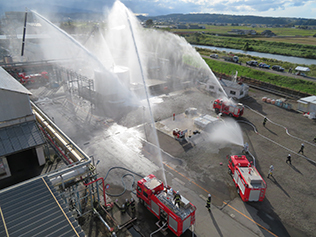
Disaster drills (Toyama Plant)
Safety Education
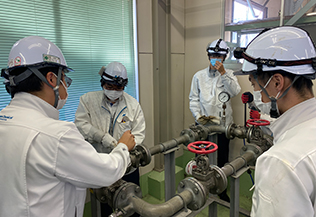
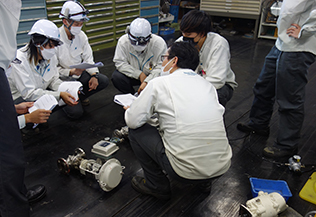
Safety Education at Training Center
We have established a training center within the Toyama Plant to provide guidance on basic facility and work methods to young employees who have worked for the Toyama Plant for less than 10 years. The lecturers are employees of the machinery, electricity, and instrumentation conservation division of the Toyama Plant. While using a model of educational equipment, they teach the importance of safe work methods by actually moving hands. This training, which has been implemented since 1991, has also accepted participants from other plants, and contributes to raising the safety awareness of the entire company.
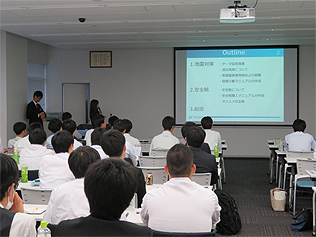
Group Safety Activities of the Laboratories
To prevent occupational accidents and raise safety awareness, young researchers at each laboratory who have been with the Company for three years or less work in groups to conduct safety-related research, discussions, and presentations over a two-year cycle. Under the guidance of senior researchers, they examine the causes of accidents and appropriate countermeasures using past occupational accident cases, HHK※, safety-related books, external information, and other materials. They also propose, implement, and evaluate accident prevention measures for their respective workplaces, thereby sharing knowledge and raising safety awareness across the laboratories. At the reporting session, an Award of Excellence is presented to the group that has undertaken the most outstanding initiatives.
- HHK stands for Hiyari-Hatto (near misses) and Kigakari (safety concerns). It refers to identifying situations that did not result in serious injury or an accident but had the potential to do so.
Analysis of Occupational Accident and Information Sharing
At business locations where occupational accidents have occurred, we conduct a thorough investigation into the causes and plan and implement emergency and permanent measures. This information is compiled as an occupational accident report, and the entire Nissan Chemical Group is working to prevent similar accidents by sharing information and promoting horizontal deployment.
We have made effort to raise awareness of safety activities by publishing occupational safety newspaper. We are also working to prevent occupational accidents at our subcontractors through safety audits.
Since FY2016, we have participated in the Anzen Project (safety project) of the Ministry of Health, Labour and Welfare. After the project ended in May 2023, we have been participating in the "SAFE Consortium."

https://anzeninfo.mhlw.go.jp/anzenproject/index.html
https://safeconsortium.mhlw.go.jp/consortium/
Safety Results
In 2025, there were two lost-time injuries at the Company. The lost-time injury frequency rate was 0.63, and the lost-time injury severity rate was 0.001. In case occupational accidents occur, we are thoroughly investigating the cause and taking permanent measures, sharing information with all offices, plants and laboratories, and promoting horizontal deployment to prevent recurrence. We will continue aiming to foster a culture of safety and achieve zero accident by promoting safety activities such as risk assessment, prior-work risk predictions, risk predictions training, HHK, 5S※ and appropriate wearing of protective equipment and by raising awareness of safety through the safety meeting, the occupational safety newspapers and safety education.
- 5S stands for Seiri, Seiton, Seisou, Seiketsu, Shitsuke. These words mean "Sort" "Set" "Shine" "Standardize" "Sustain" respectively.
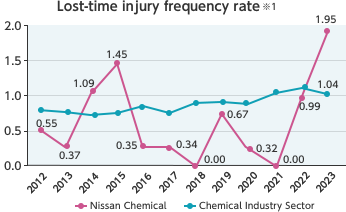
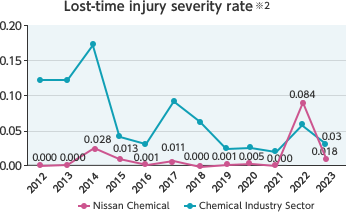
- 1 Total number of deaths and injuries caused by labor accidents per 1 million actual working hours
- 2 Total number of working days lost per 1,000 working hours
Chemical industry sector: Quoted from the Ministry of Health, Labor and Welfare “Overview of Trend Survey on Industrial Accidents (Survey of Business Establishments (establishments with 100 or more employees) and Comprehensive Construction Industry Survey)”