



 Close
Close
Corporate Profile
- HOME >
- Corporate Profile >
- Corporate Governance
Corporate Governance
Policy/Philosophy
We think of corporate governance as a mechanism that ensures sound, efficient management to provide stakeholders with sustainable, medium- to long-term profits. Based on this idea, we strive to ensure management decisions are made promptly, and work to clarify the management responsibility and responsibility for executing operations. At the same time, we take initiatives for strengthening the management’s monitoring function, compliance, risk management, and internal control system under our Board of Directors and Audit & Supervisory Board, whose members include highly independent outside officers.
Compliance with the Corporate Governance Code
We comply with every principle of Japan's Corporate Governance Code.
Strategic Shareholdings
The Company has established the following items regarding strategic shareholdings.
(1) Policy on strategic shareholdings
Each year, the Board of Directors comprehensively discusses the Company’s strategic shareholdings, including aspects such as the necessity of maintaining or enhancing transactional and other relationships with the investee company, whether the benefit of holding the shares is commensurate with the capital cost, and whether such holdings will contribute to increases in the Company’s corporate value over the medium to long-term. If no rationality for holding the shares can be confirmed, then the shares are sold, while also giving consideration to the impact on the market and other pertinent matters.
(2) Policy on the exercise of voting rights on strategic shareholdings
Before exercising its voting rights, the Company comprehensively determines whether it approves or rejects each of the proposals, giving adequate weight to the management policies, strategies, and other aspects of the investee company and confirming such factors as whether the proposals would comply with the Company’s holding policy and whether they would contribute to increasing the investee company’s corporate value over the medium to long-term and its shareholder returns.
Policy and Procedures in the Nomination of Officer Candidates
Nominations of director candidates and audit & supervisory board member candidates are explained in advance to the independent outside directors. Then, after receiving appropriate advice from the independent outside directors and the contents of the Nomination and Remuneration Advisory Committee’s deliberation, the Board of Directors passes a resolution. The candidates are then proposed at the General Meeting of Shareholders. Nominations of Audit & Supervisory Board member candidates are approved by Audit & Supervisory Board in advance.
Policy
| Directors | We operate business activities globally in diverse fields, including chemicals, performance materials, agricultural chemicals, and healthcare. In nominating candidates for our directors, we consider the balance between knowledge, experience, capabilities, and other elements of the overall Board of Directors and its diversity to ensure that our directors can make decisions regarding the business activities in diverse fields, including chemicals, performance materials, agricultural chemicals, and pharmaceuticals, and supervise the execution of operations in an appropriate and flexible manner. The candidates to be nominated shall also be physically and mentally healthy, have excellent personalities and aspirations, and have a high level of insight and ethics. <Inside Directors> Human resources who have expertise, knowledge and other capacities in each business field such as corporate planning, personnel, finance & accounting, research and development, production technology, environment, safety & quality assurance and others. <Outside Directors> Human resources who are capable of giving opinions proactively, raising questions and giving advice on growth strategies, the enhancement of governance and other issues from the viewpoints of various stakeholders and society. Each outside director may serve up to six terms of one year in total; provided, however, that shall not prevent the director from serving up to eight terms of one year in total under a special circumstance. Each outside director may concurrently serve as a director or Audit & Supervisory Board member of five listed companies, including the Company, at a maximum in principle. |
|---|---|
| Audit & Supervisory Board Members | Human resources with a wide range of experience and knowledge in specialized fields including finance, accounting, and legal affairs who are capable of giving opinions and advice to the management from a fair and neutral standpoint, in addition to auditing the execution of operations. Each Audit & Supervisory Board member may serve up to two terms of four years in total; provided however, that shall not prevent the member from serving up to three terms of four years in total under a special circumstance. Each Audit & Supervisory Board member may concurrently serve as a director or Audit & Supervisory Board member of five listed companies, including the Company, at a maximum in principle. |
Reasons for Appointment of Outside Officer and their attendance
| Name | Reason for appointment | Attendance at the Board of Directors meetings in FY2025 (Number of attendance / Number of meetings held) | |
|---|---|---|---|
| Outside Directors |
KATAOKA Kazunori Appointed in June 2020 |
Mr. KATAOKA has been engaged in research involving the application of nanotechnologies in the fields of biomedical engineering and biomaterial engineering for many years and is currently serving as the Director General of Innovation Center of NanoMedicine, Kawasaki Institute of Industrial Promotion. We believe that his expertise as doctor of engineering, abundant experience, and wide-ranging knowledge will be reflected in our corporate management from an outside perspective and from an objective standpoint. | 12/12 |
| NAKAGAWA Miyuki Appointed in June 2021 |
Ms. NAKAGAWA Miyuki worked for many years as a prosecutor in the Tokyo District Public Prosecutors Office and the Tokyo High Public Prosecutors Office and she has abundant practical experience in legal circles. We believe that her expertise as legal profession, abundant experience, and wide-ranging knowledge will be reflected in our corporate management from an outside perspective and from an objective standpoint. | 12/12 | |
| TAKEOKA Yuko Appointed in June 2023 |
Ms. TAKEOKA Yuko has been engaged in research centered on the synthesis and characterization of functional polymers for many years, and is currently serving as a Professor of Department of Materials and Life Sciences, Faculty of Science and Technology, Sophia University. We believe that her expertise as doctor of engineering, abundant experience, and wide-ranging knowledge will be reflected in our corporate management from an outside perspective and from an objective standpoint. | 12/12 | |
| HAMA Itsuo Appointed in June 2025 |
Mr. HAMA Itsuo served as Representative Director, Chairman of the Board of Directors of Lion Corporation, and after that, he has been serving as an Executive Advisor of that company. We believe that his abundant experience and wide-ranging insight as an experienced manager of a corporate group active in diverse sectors of global business centered in Asia will be reflected in the management of the Company from an outside perspective and from an objective standpoint. | 10/10 |
| Name | Reason for appointment | Attendance at the Board of Directors meetings, etc. in FY2025 (Number of attendance / Number of meetings held) | |
|---|---|---|---|
| Outside Audit & Supervisory Board Members | TAKAHAMA Shigeru Appointed in June 2024 |
Mr. TAKAHAMA has been engaged in auditing duties of numerous listed companies for many years as a certified public accountant. We believe that his advanced expertise in corporate accounting, abundant experience and wide-ranging knowledge will be reflected in the audit of the Company from an outside perspective and from an objective and neutral standpoint. | Board of Directors meetings: 12/12 Audit & Supervisory Board’s meetings: 12/12 |
| KINUGAWA Sachie Appointed in June 2025 |
Ms. KINUGAWA was engaged in work at financial institutions for many years, and after that, she had served as President & CEO (Representative Director) of Mizuho Business Partner Co., Ltd. since April 2021. She possesses abundant experience, notably in corporate management, and wide-ranging insights that include financial expertise. We believe that these skills will be reflected in the audit of the Company from an outside perspective and from an objective and neutral standpoint. | Board of Directors meetings: 9/10 Audit & Supervisory Board’s meetings: 10/10 |
|
| OZEKI Yukimi Appointed in June 2026 |
Ms. OZEKI Yukimi has been engaged in research centering on corporate law and corporate governance for many years and is currently serving as a professor at Chuo Law School. We believe that her expertise as a doctor of Laws, abundant experience and wide-ranging knowledge will be reflected in the audit of the Company from an outside perspective and from an objective and neutral standpoint. | - |
Independence Standards for Independent Outside Directors
The Company’s independence standards for Outside Officers are as follows:
The Company’s independent Outside Officers (Directors and Audit & Supervisory Board Members) and independent Outside Officer candidates fulfill the Companies Act’s requirements for Outside Officers, as well as the following independence standards.
(1) Not being an executive (a person who executes business; hereinafter, the same) of the Company or its subsidiaries, nor having been an executive of the Company or its subsidiaries for the past 10 years (if however, a non-executive director or audit & supervisory board member of the Company or its subsidiaries at some point in the past 10 years, the 10 years prior to being appointed to that role)
(2) Not being one of the Company’s major shareholders (a shareholder with 10% or more of voting rights) or an executive thereof
(3) Not being an executive of a corporation of which the Company is a major shareholder (a shareholder with 10% or more of voting rights)
(4) Not being a major client or supplier (a client or supplier from whom the value of average payments for transactions to the Company or its subsidiaries over the past 3 fiscal years exceeds 2% of the average annual consolidated net sales of the Company over the past 3 fiscal years) of the Company or its subsidiaries or an executive thereof
(5) Not being a party whose major client or supplier is the Company or its subsidiaries (a party to whom the value of average payments for transactions by the Company or its subsidiaries over the past 3 fiscal years exceeds 2% of the average annual consolidated net sales of that party over the past 3 fiscal years), or an executive thereof
(6) Not being an executive of a major financial institution with which the Company has borrowings (a financial institution from whom the average amount of the Company’s consolidated fiscal-year-end balance of borrowings over the past 3 fiscal years exceeds 2% of the Company’s average annual consolidated fiscal-year-end total assets over the past 3 fiscal years) nor having been an executive thereof for the past 3 years
(7) Not being an attorney, certified public accountant, certified public tax accountant, other consultant, researcher or educator in receipt from the Company of a large amount of monetary consideration or other property (an average annual amount over the past 3 fiscal years of over ¥10 million for individuals or, in the event the recipient is a corporation or other organization that said individual is affiliated with or retained by, of an amount in excess of 2% of that organization’s average annual total revenues over the past 3 fiscal years) other than Director or Audit & Supervisory Board Member remuneration
(8) Not being a close relative (spouse, person within the second degree of kinship or relative living together) of an executive (limited to key personnel) of the Company or its subsidiaries
(9) In addition to items (1) through (8) above, being such person as the Board of Directors determines to be a person whose independence as an independent Outside Officer is unquestionable and for whom there is no rationally determined risk of a conflict of interest with the general shareholders of the Company.
Overview of Succession Plan for President and CEO
(1) Purpose of Succession Planning
To ensure the Company’s sustainable development and enhancement of the mid-to-long term corporate value, we, the Company, recognize that it is indispensable to replace our President and CEO with an adequate successor at an appropriate time. To actualize such replacement, we formulate the “Succession Plan for President and CEO” (“Plan”), which is resolved by the Board of Directors.
(2) Basic Idea
In the Plan, looking at the future replacement of our President and CEO, we select and train potential candidates for succession and develop their knowledge, skills, and abilities as required before identifying a person who perfectly fits, as a principle.
(3) Road Map
We compile a road map of necessary processes to implement the Plan appropriately.
(4) Roles and Functions
In the Plan, the President and CEO, the Nomination and Remuneration Advisory Committee, and the Board of Directors have their respective roles and functions as follows:
- 1)President and CEO
The President and CEO prepares an original draft of the Plan and puts it into practice. - 2)Nomination and Remuneration Advisory Committee
To enhance its supervisory function in the Plan, the Committee thoroughly reviews and deliberates the original draft of the Plan and its implementation progress and reports it to the Board of Directors to support their proactive engagement in the Plan. - 3)Board of Directors
Based on the Committee’s report, the Board of Directors checks the implementation progress and oversees the whole process so that the Plan is appropriately carried out through its proactive engagement.
Policy on Determination of Officers' Remuneration
1. Basic policy
In determining remuneration for the Directors, the Company establishes a remuneration structure under which the Directors seek to improve the Company’s medium- to long-term performance continuously and contribute to enhancing the corporate value of the Group as a whole, in line with the Company’s management policy, thereby meeting the shareholders’ expectations.
Specifically, the Directors’ remuneration package shall consist of monetary remuneration (base remuneration and performance-related remuneration) and performance-linked stock compensation. However, the remuneration for Outside Directors shall consist solely of base remuneration within monetary remuneration, and in light of their roles and independence from the Company, it shall neither include performance-related remuneration within monetary remuneration nor performance-linked stock compensation.
The performance-linked stock compensation aims to heighten awareness of the Directors (excluding Outside Directors) to contribute to improving the Company’s medium- to long-term performance and enhancing corporate value by further clarifying the linkage with the Company’s performance and stock value, and by sharing with shareholders not only the benefits from stock price appreciation, but also the risk of its decline.
The remuneration levels and the proportions by remuneration type shall be appropriately set, considering the Company’s performance and using data from other companies of similar business size to the Company or from related business types and categories as benchmarks.
2. Policy on determining the respective amounts of monetary remuneration (base remuneration and performance-related remuneration) for individual Directors (including rules on determining the timing or the conditions of granting remuneration)
The base remuneration within monetary remuneration for the Directors shall be fixed pay. Its annual amount shall be determined based on their job titles and responsibilities through a comprehensive consideration of the levels of other companies’ directors’ payments, the Company’s business performance, and the levels of our employees’ salaries.
For performance-related remuneration within the monetary remuneration for the Directors, the base amount shall be set by job title, and the annual amount shall be determined in line with fluctuations in performance metrics. These performance metrics shall be profitability indicators for the previous year (current net profit attributable to owners of parent, EBITDA, and the like) and ESG indices (a third-party assessment, reduction in greenhouse gas emission, and the like).
These monetary remunerations shall be paid to each Director every month in twelve installments of the annual amount, within the limits of the total amount of the Directors’ remuneration determined by resolution of a general meeting of shareholders.
3. Policy on determining details of performance-linked stock compensation, the breakdown of performance metrics, and the methodology to calculate the amount or the figure for performance measurement (including rules on determining the timing or the conditions for granting remuneration)
As for the performance-linked stock compensation for the Directors, the Company shall deliver to each Director taking the following steps: it computes a specific number of performance points for each Director by multiplying (i) their title point depending on the job title which they have assumed during the execution of duties by (ii) the performance evaluation indices consisting of ROE (actual return on equity for the current business year) and the Company’s 3-year TSR (comparison with 3 year-increase/decrease rate of the stock price index, and comparison with the leading market capitalization companies with similar business to the Company in the chemical sector); it grants the calculated number of performance points to each Director up to the limit determined by resolution of a general meeting of shareholders; and through the Board Benefit Trust contributed by the Company in money up to the limit determined by resolution of a general meeting of shareholders, it delivers to each Director with a specific number of the Company Shares equivalent to the number of their accumulated performance points upon their retirement. If a Director retires due to the expiry of their term of office, the Company will deliver the Company Shares equivalent to approximately 75% of the accumulated performance points and the cash equivalent to the remaining approximately 25% (which sum is computed at the stock price of the Company Share as of the date of their retirement).
The performance metrics and their targets to be achieved for granting performance points to the Directors shall be reset to align with the Company’s medium-term management plan every time it is formulated, or shall be reviewed, as necessary, in light of the circumstances surrounding the corporate management, and determined by resolution of the Board of Directors based on an opinion report from the Nomination and Remuneration Advisory Committee (or “Committee”).
The system to confiscate the beneficiary’s right (right to receive remuneration) from a Director (so-called “Malus Clause”), and the same to demand the repayment of remuneration from a Director (so-called “Claw-back Clause”) shall be specified. If a Director conducts a certain illegal action or there are other special circumstances, the application of those Clauses shall be determined by resolution of the Board of Directors based on an opinion report from the Committee.
4. Policy on determining the proportion of monetary remuneration or the performance-linked stock compensation to the total remuneration for individual Directors
The proportion of remuneration by type for the Directors (except for Outside Directors) shall be deliberated by the Nomination and Remuneration Advisory Committee based on the remuneration level to be set using data from other companies of similar business size to the Company or from related business types and categories as benchmarks. The Board of Directors shall respect the report on deliberation result from the Committee and determine details of remuneration for individual Directors within the respective limits of each total amount of remuneration by type suggested in the report.
The proportion of remuneration by type shall be reset each time the Company’s medium-term management plan is formulated, or shall be reviewed, as necessary, in light of the circumstances surrounding the Company’s business management, and determined by resolution of the Board of Directors based on the opinion report from the Committee.
The ratio of monetary remuneration (base remuneration), monetary remuneration (performance-related remuneration), and performance-linked stock compensation, after revision in business year 2026, is roughly 50:30:20 (where the achievement degree of the performance metrics is 100%).
5. Matters regarding the decision on details of remuneration for individual Directors
The amount of monetary remuneration (base remuneration and performance-related remuneration) for individual Directors shall be determined by resolution of the Board of Directors. The Board of Directors shall submit to the Nomination and Remuneration Advisory Committee an original plan for those respective amounts drafted by the Representative Director and seek advice and receive an opinion report from the Committee. The Board of Directors shall respect that opinion in the report and make the decision.
6. Other matters regarding the process to determine details of remuneration for individual Directors
The Company has established a Nomination and Remuneration Advisory Committee as an advisory body to the Board of Directors. To decide the establishment, amendments, or abolishment of policies and related rules for the Directors’ remuneration, or to ensure the appropriateness of the remuneration levels as well as objectivity and transparency of the decision-making process for determining the Directors’ monetary remuneration, the Company shall seek deliberation by and an opinion report from the Committee. The Committee shall consist of three or more members, to be appointed by resolution of the Board of Directors, and independent Outside Directors shall constitute a simple majority of the Committee.
System
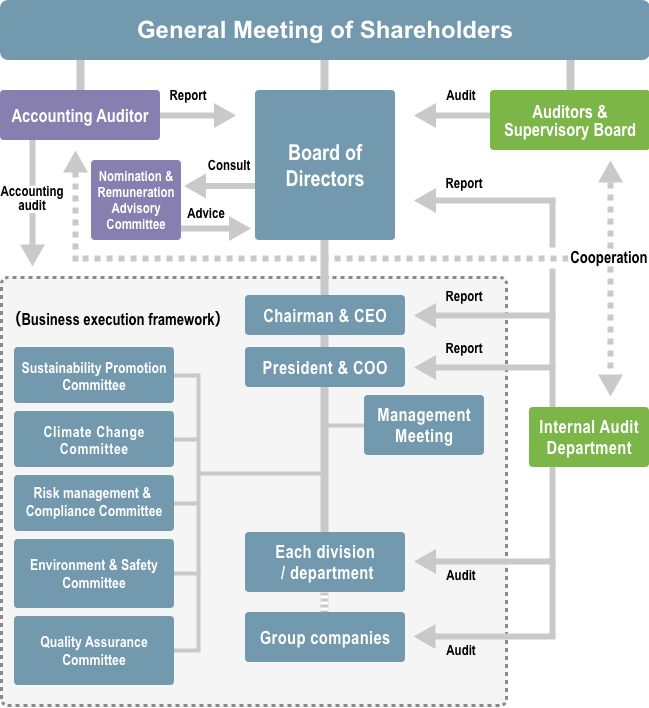
Our Corporate Governance System
Execution and supervision of operations
By introducing a system with executive officers, we clarify the management’s function of prompt decision-making and supervision and the function of executing operations, thereby strengthening both. We also strive to improve management’s capabilities to develop and execute our management strategies. In addition, we have set a one-year term for each director and executive officer, thereby clarifying the management responsibility and the responsibility for executing operations.
Board of Directors
Our board meets monthly in principle, to resolve important management matters. It also supervises the execution of operations by directors and executive officers. We ensure that important management matters are determined through careful deliberations at the Board of Directors meetings or management meetings in our efforts to eliminate or reduce business risks. In addition, the details of decisions made at the management meetings and the results of business executions based on decisions made at the Board of Directors meetings, etc. are reported to the Board of Directors to enhance the supervising function of the Board of Directors meeting. We further strive to ensure and improve effectiveness in execution of roles and responsibilities of the Board of Directors by conducting the effectiveness evaluation on the overall Board of Directors every fiscal year.
Audit & Supervisory Board
We have established the Audit & Supervisory Board. In accordance with auditing plans formulated by the Audit & Supervisory Board, the Audit & Supervisory Board members audit the execution of directors’ operation by participating in the Board of Directors meetings and other important meetings, and by regularly visiting each division / department of the Head Office and plant / laboratory to exchange opinions.
Accounting Audit
We have appointed the Yaesu Audit Company as our accounting auditor. They audit at the end of each fiscal year, and during the fiscal year when necessary.
Internal Audit
We have established an Internal Audit Department to pursue the achievement of the Group’s management objectives effectively. With the object of ensuring the proper duties under the internal control system, the Internal Audit Department conducts internal audits for the Group. The department submits its internal audit activity plan and reports the outcomes to the Chairman & CEO, the President & COO, the directors in charge, and the Board of Directors. It also shares information with our accounting auditor and the Audit & Supervisory Board members to cooperate with them.
Support System for Outside Directors and Audit & Supervisory Board Members
1. Support system for Outside Directors
(1) The Corporate Planning Department and related departments provide Outside Directors with prior explanations on the content of proposals to be deliberated at the Board of Directors and other important matters. The Corporate Planning Department serves as a liaison for the Outside Directors.
(2) To provide an opportunity to deepen their understanding of the Company’s businesses, the Company conducts Outside Directors’ inspection visits to its offices, bases (factories/laboratories), or subsidiaries, every year, according to [a year-round] schedule.
2. Support system for Outside Audit & Supervisory Board Members
(1) The Corporate Planning Department and related departments provide the Outside Audit & Supervisory Board Members with prior explanations on the content of proposals to be deliberated at the Board of Directors and related matters. The Corporate Planning Department serves as a liaison for the Outside Audit & Supervisory Board Members.
(2) If requested by Audit & Supervisory Board Members, the Company assigns an employee as an assistant to the Audit & Supervisory Board Members to facilitate the efficient and smooth execution of their duties. That assistant aids audits, gathers and communicates information, and performs related tasks.
Nomination and Remuneration Advisory Committee
We have established under the Board of Directors a Nomination and Remuneration Advisory Committee mostly consisting of independent outside directors for the purpose of strengthening the Board of Directors’ independence, objectivity and accountability in relation to matters such as the nomination and remuneration of Directors and further strengthening corporate governance. In response to the Board of Directors’ request for consultation, the Committee shall deliberate the matters such as the nominations of director candidates and Audit & Supervisory Board member candidates, the appointment of senior management, the plans for successors of senior management, and the remuneration of directors, and report the contents of their deliberations to the Board of Directors.
Relationships between our corporate organizations and internal control, etc.
Indicators
Governance System※
| Indicator | Scope | Unit | FY2022 | FY2023 | FY2024 | FY2025 | |
|---|---|---|---|---|---|---|---|
| Directors | Inside directors | Male | People | 6 | 6 | 6 | 6 |
| Female | People | 0 | 0 | 0 | 0 | ||
| Total | People | 6 | 6 | 6 | 6 | ||
| Outside directors (Independent) |
Male | People | 3(3) | 2(2) | 2(2) | 2(2) | |
| Female | People | 1(1) | 2(2) | 2(2) | 2(2) | ||
| Total | People | 4(4) | 4(4) | 4(4) | 4(4) | ||
| Altogether | People | 10(4) | 10(4) | 10(4) | 10(4) | ||
| Ratio of independent outside directors | % | 40 | 40 | 40 | 40 | ||
| Ratio of female directors | % | 10 | 20 | 20 | 20 | ||
| Audit & Supervisory Board members | Inside Audit & Supervisory Board members | Male | People | 1 | 1 | 1 | 1 |
| Female | People | 0 | 0 | 0 | 0 | ||
| Total | People | 1 | 1 | 1 | 1 | ||
| Outside Audit & Supervisory Board members (Independent) |
Male | People | 3(3) | 3(3) | 3(3) | 2(2) | |
| Female | People | 0 | 0(0) | 0(0) | 1(1) | ||
| Total | People | 3(3) | 3(3) | 3(3) | 3(3) | ||
| Altogether | People | 4(3) | 4(3) | 4(3) | 4(3) | ||
| Ratio of independent outside Audit & Supervisory Board members | % | 75 | 75 | 75 | 75 | ||
| Ratio of female Audit & Supervisory Board members | % | 0 | 0 | 0 | 25 | ||
- Data is as of after the General Meeting of Shareholders held in June of each year.
Number of Major Meetings and Attendances※
| Indicator | Unit | FY2022 | FY2023 | FY2024 | FY2025 |
|---|---|---|---|---|---|
| Board of Directors meeting | Times | 12 | 12 | 12 | 12 |
| Attendance of directors at Board of Directors meetings | % | 98.3 | 99.2 | 100 | 100 |
| Attendance of Audit & Supervisory Board members at Board of Directors meetings | % | 100 | 100 | 100 | 97.9 |
| Audit & Supervisory Board’s meeting | Times | 12 | 12 | 12 | 12 |
| Attendance of outside Audit & Supervisory Board members at Audit & Supervisory Board’s meetings | % | 100 | 100 | 100 | 100 |
- Data from April to March of each fiscal year
Officers' Remuneration
| Indicator | Unit | FY2022 | FY2023 | FY2024 | FY2025 | |
|---|---|---|---|---|---|---|
| Directors | Remuneration | Million Yen | 466 | 471 | 457 | 491 |
| Number of officers※1 | People | 13 | 11 | 10 | 12 | |
| (outside directors) | Remuneration | Million Yen | (51) | (52) | (52) | (52) |
| Number of officers※1 | People | (4) | (5) | (4) | (5) | |
| Audit & Supervisory Board members | Remuneration | Million Yen | 96 | 98 | 86 | 69 |
| Number of officers※1 | People | 5 | 4 | 4 | 5 | |
| (outside Audit & Supervisory Board members) | Remuneration | Million Yen | (67) | (68) | (56) | 38 |
| Number of officers※1 | People | (3) | (3) | (4) | (4) | |
| Total※2 | Remuneration | Million Yen | 562 | 570 | 543 | 560 |
| Number of officers※1 | People | 18 | 15 | 15 | 17 | |
- 1 Above number of Directors and Audit & Supervisory Board Members, remuneration , etc. include remunerations for officers who resigned at the close of General Meeting of Shareholders. There are no officer’s remuneration, etc. received by outside officers from our subsidiaries.
- 2 Due to rounding off figures, there are places where the sums for each item do not match the total.
Activities
Analysis and Evaluation of the Board of Directors’ Effectiveness as a Whole
Overview of Effectiveness Evaluation of the Board of Directors
Every year since fiscal year 2015, the Company has analyzed and evaluated to assess whether our Board of Directors has fulfilled its key roles and responsibilities (“Effectiveness Evaluation”). For the evaluation process, primarily employing the self-assessment process by the Board of Directors, the Company alternatively conducts a third-party evaluation every three (3) years using an external organization with no relationship of interest to us to ensure the neutrality and objectivity of the evaluation.
For the Effectiveness Evaluation for fiscal year 2025, the Board of Directors conducted it through a self-assessment. At its meeting held in April 2026, the board members shared the questionnaire responses, based on which it analyzed, evaluated, and discussed the issues to address. At its meeting held in May 2026, the board members further deliberated and confirmed the outcomes of their analysis and evaluation, the selection of priority issues to address, and the action plan to solve those issues.
Overview of the Results of the Effectiveness Evaluation
With the object of performing its key roles and responsibilities, the Effectiveness Evaluation concluded that, generally, our Board of Directors was operating appropriately in its totality, improvements have been made to address issues identified in the Effectiveness Evaluation for the fiscal year 2024. Thus, the effectiveness of our Board of Directors was positively assessed and confirmed as being sufficiently ensured.
*Issues identified in the Effectiveness Evaluation for fiscal year 2024 and initiatives implemented in fiscal year 2025 are as follows:
- 1)Issues identified in the Effectiveness Evaluation for fiscal year 2024
*To deepen our discussions on how to approach “risk-taking in investment” and what principles to follow. - 2)Initiatives implemented in fiscal year 2025
*The Board of Directors had free discussions to exchange views on the agenda, “how to approach risk-taking in investment, over four occasions. Based on those free discussions, the board reported “Measures for Enhancement of Discussions on Investment at the Board” at its meeting in December, 2025.
Actions to Take
The Board of Directors acknowledged the following points as priority issues to address in fiscal year 2026 and confirmed the action plan to take as follows.
(1) Priority Issues to address:
- i)We should deepen our discussions on the Company’s policies from a long-term perspective, including the next medium-term management plan.
- ii)We should secure sufficient time to discuss the issues identified and confirm the progress of addressing them.
(2) Action plan:
- i)We should focus on deliberation of the broad picture agenda, which will underlie the formulation of the next medium-term management plan, including the ideal state that the Company should aim for, and the optimal business portfolio for the Company.
- ii)We should discuss how to make improvements in addressing the issues identified through the Effectiveness Evaluation, and monitor the progress of improving them.